
All Is (Q-)Number
In a world full of headlines touting ‘the latest theory of everything’, the most valuable unturned stone might be the theories we have had for a century. We just need the courage to do as Sam Kuypers does and take them seriously.
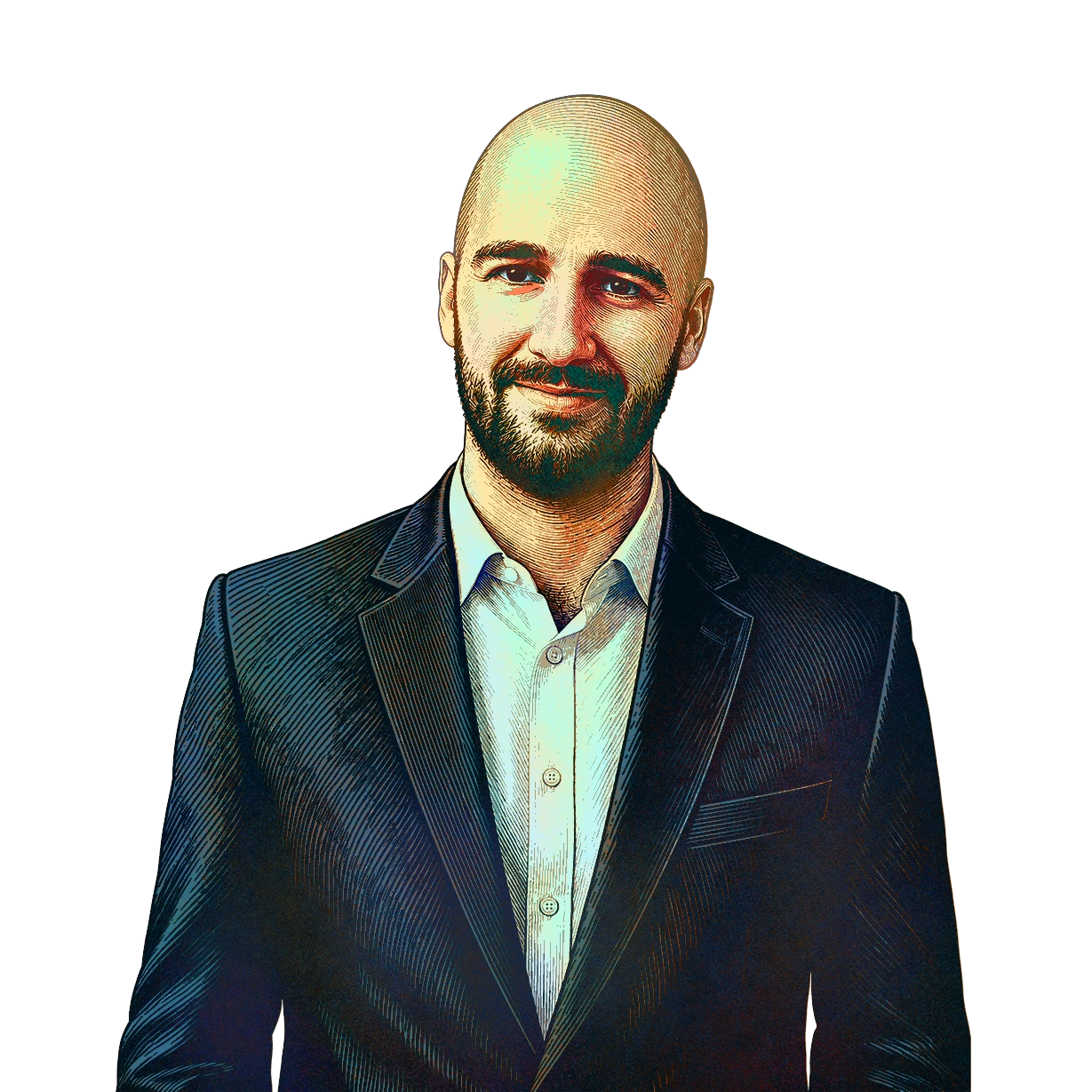
Three major influences drew Conjecture Institute Fellow Sam Kuypers to physics as a teenager: a high school course, Richard Feynman videos, and his father.
“For some reason, my dad had loads of in-depth knowledge about the theory of circuits and electronics,” Sam recalls. “He also knew a great deal about classical mechanics, and almost anything else that came up in secondary-school physics. Somehow he had retained nearly all of it over the years. So I’d tell him about my physics class that day, and the two of us would talk about it for hours. Talking with him was much more interesting than the classes themselves; he had a way of bringing the material to life. Our conversations made me realize how valuable one-on-one interactions are for learning.”
Sam fell in love with the counterintuitive facts that Newtonian mechanics told us about the world. That objects launched from the ground would slow down until they had a vertical velocity of literally zero for just a moment at the top of their trajectory struck Sam as both bizarre and fascinating. Moreover, he was not only captivated by the facts and theories of physics, but also by the fact that we could know them—hinting at his future passion for epistemology, the philosophy of knowledge.
“When I was young and new to physics, I was blown away by the fact that, even if you didn’t know the particular path that a projectile took, you could know that it would hang still in the air for just a moment—that is, its vertical velocity must be zero at some point, unless it went off into space,” Sam recalls. “It seemed like a bold claim to make. But it is, of course, true.”
Sam would go on to attend the University of Amsterdam, where he would earn a bachelor’s degree in physics and astronomy and a master’s in theoretical physics. During this time, his primary interest was condensed matter theory, the study of how vast numbers of particles conspire together to give rise to emergent phenomena like superconductivity and magnetism.
Sam’s early interest in the subject planted the seeds of his eventual fascination with quantum theory, which has come to define much of his work.
“Condensed matter theory is basically the theory of macroscopic systems—of things like magnets, metals, and semiconductors,” Sam says. “I thought it was boring at first because it didn’t seem fundamental, but the more I delved into it, the more interesting it became. I realized that, although the systems described by the theory are very large, most of their properties are quantum mechanical. This led me to puzzle over an odd discrepancy—people would say that only the microscopic world was described by quantum mechanics, yet we clearly have quantum mechanical descriptions of macroscopic systems. So I became more interested in quantum foundations, since this widely accepted contradiction, inherent to conventional explanations of quantum theory, made no sense to me.”
In his final year as an undergraduate, Sam would read physicist David Deutsch’s books, The Fabric of Reality and The Beginning of Infinity, both of which argue for the Many-Worlds interpretation of quantum mechanics (also called ‘Everettian quantum theory’). The books completely changed Sam’s worldview, not least because he saw that there was actually a solution to many of the issues he had been noticing in quantum mechanics.
“I was totally persuaded by everything, but I had my doubts about Everett,” Sam says. “So I read Everett’s long thesis to check the math, and it worked! So I was persuaded, and now it’s one of the main things I work on.”
With his interest in quantum foundations firmly in place, Sam applied for a PhD position at the University of Oxford, in physicist Vlatko Vedral’s group. There, he would apply Everettian quantum theory to a variety of open problems in the foundations of physics, such as time travel, the quantum theory of time, and the so-called Heisenberg picture of quantum theory.
“I wanted to see how far you could push the Everettian model in all of these directions,” Sam says.
In Sam’s thesis, Developments in unitary quantum theory, he:
- Showed that Everettian universes are local, like bubbles that grow but are independent of their exterior (more technically, he demonstrated that Everett’s relative-state construction was viable in the Heisenberg picture),
- Identified and articulated a principle implicit in quantum theory: that the descriptors of physical systems are q-number valued (rather than c-number valued—see Box 1),
- Demonstrated that it is possible to express quantum theory without invoking classical notions of time in the Heisenberg picture, and
- Developed the theory of unorthodox quantum theory, which relinquishes a problematic assumption in orthodox quantum theory called the commutation constraint.
Much of this work would live on in Sam’s earliest scientific papers (see Boxes 1 and 2 for details).
What unifies Sam’s thesis and corresponding papers is that they all take quantum theory seriously as a fundamental description of reality. Even though the Schrödinger and Heisenberg pictures make equivalent predictions, Sam took the latter to be more fundamental, and that, therefore, problems that had been solved only in the Schrödinger picture needed solving in the Heisenberg picture, too. And even though collapse models of quantum theory ‘worked’ for most practical purposes, only Everett’s relative-state construction and corresponding Many-Worlds interpretation actually made sense of quantum theory. Combining these two explanatory improvements to traditional views of quantum theory—the Heisenberg picture over the Schrödinger picture and Everett’s relative-state construction over collapse models—Sam solved problems in physics’ theoretical edifice for which the older perspectives on quantum theory never could.
Nor was it enough for Sam to think of quantum theory as ‘just’ an equation that described the evolution of physical systems over time—his fundamental principle of quantum mechanics is a deeper characterization about what the theory is all about than any single algebraic equation could possibly be. As he writes, “‘quantum theory’ is better thought of as a collection of theories that comply with this fundamental principle…The reason why quantum theory is better thought of as a set of principles is that it does not describe particular systems…Quantum theory is not about any of those systems in particular [atoms, photons, superconductors, quantum computers], but about all of them—or rather, it is about what kinds of theories can describe physical objects.”
Sam had been quite fortunate to earn his PhD under Vlatko, who had been laissez-faire with respect to what sort of research Sam could or could not pursue. Even so, the university itself had a different, more paternalistic philosophy.
“There was a stark contrast between Vlatko’s wonderful willingness to just let me work on anything I wanted and Oxford’s policies,” Sam remembers. “For example, every few months I’d have to regularly justify my research to a person in charge of research students. These online check-ins gave me mild anxiety—after all, what if I hadn’t made enough progress since our last meeting to satisfy him? Or what if he didn’t approve of what I had been working on?”
Academia’s Boundary Conditions
After graduating with his PhD, Sam acquired a postdoctoral position in Lugano, Switzerland, working under quantum information scientist Stefan Wolf. Conjecture Institute Fellow Charles Bedard had been working under Wolf at the time, and he had gladly helped to earn Sam the position. While in Lugano, Sam would continue his work on the quantum theory of time, co-authoring a second paper on the subject alongside Simone Rijavec titled “Measuring time in a timeless universe”.
“It was a really nice group, and I enjoyed my many discussions with Charles,” Sam recalls. “I was able to continue working on problems that I was interested in.”
Following his time in Lugano, Sam took a second postdoctoral position under quantum information scientist Gilles Brassard at the Université de Montréal. It was here that he became close with another Conjecture Institute Fellow, Paul Raymond-Robichaud, who lived nearby.
“We saw each other quite a lot,” Sam says. “And he persuaded me that mathematics was not taken seriously enough by physicists. As a whole, physicists tend to use mathematics rigorously enough to get by, but Paul explained to me why physics would benefit from holding their work up to the standards of mathematicians when developing their proofs and theorems. Ever since, I’ve tried to do exactly that in my work.”
Sam was not merely persuaded by Paul’s general arguments, but also by Paul’s own work on formalizing the notion of local-realism. Sam and Conjecture Institute Fellow Maria Violaris are now applying Paul’s formulae to the physics of information. In particular, they are taking both Paul’s notion of local-realism and the constructor theory of information to solve problems having to do with differences between locally accessible information and locally inaccessible information.
Paul’s influence on Sam would also be felt in Sam’s chapter contribution to Alyssa Ney’s compendium, Local Quantum Mechanics: Everett, Many Worlds, and Reality, which he also wrote during his time in Canada. His chapter, ‘Restoring Locality: The Heisenberg Picture as a Separable Description of Quantum Theory’, explains how local realism is respected in quantum theory, despite appearances and the popular consensus. Something of a review, Sam walks the reader through the historical context of the problem, how it was eventually solved by Deutsch and Patrick Hayden in 2000, and Paul’s original contributions a couple of decades later.
Throughout his academic career, Sam experienced pressure by academic bureaucracy and funders alike to stick to a preset list of research topics. Any public funding he received during that time came with an expectation that he would satisfy some particular goal. But the questions Sam asks in his research do not yet have known solutions—that is why he pursues them in the first place! And if the solution cannot be known before the question is pursued, then neither can any arbitrary goal.
For example, Kuypers and Deutsch successfully provided a local account of branching using the Heisenberg picture, allowing them to describe universes that exist at remote locations from one another as separate systems with independent dynamics. But, strictly speaking, whether such a description was possible was not known beforehand, and so nobody could have known how this research would pan out. Conceivably, no local description of branching existed, in which case demonstrating that could itself have become a research project, which would have opened up further problems to work on. For example, it could have laid bare a fundamental discrepancy between the Schrödinger and Heisenberg pictures, in that in this hypothetical scenario one would support the relative-state construction while the other would not. This discrepancy would itself demand explanation. Now, this entire sequence of events would have been genuine progress in fundamental physics—and yet, most criteria that a funder would have attached to their funding of Sam, or guidelines insisted upon by the university system, could not have possibly been satisfied by both this outcome and the outcome that Sam actually achieved.
A New Quantum Mechanics: Textbook and Application
Since Sam became a Conjecture Institute Fellow in 2025, he has so far pursued two main projects.
The first is that he has continued to co-write a much-needed textbook on quantum mechanics alongside Deutsch and Conjecture Institute Senior Scientist Chiara Marletto. The Heisenberg picture and the Everett interpretation are both drastically underappreciated in the halls of academia, yet they have been and will continue to be vital for making progress in fundamental physics. The overwhelming majority of quantum mechanics textbooks downplay the Heisenberg picture and equivocate on the Everett interpretation at best and endorse an instrumentalist view of quantum physics at worst. They also tend to use unnecessarily complicated examples such as, say, the hydrogen atom and harmonic oscillators that require the reader to grok concepts and mathematical superstructures that are not intrinsic to the principles of quantum theory. Imagine if our best textbook on evolutionary theory today was written before the revolution of the selfish gene model, or if our best textbook on special relativity was written before the Minkowski spacetime was invented. That is precisely where we are with respect to quantum mechanics textbooks—there is scope for an update. To that end, Deutsch, Marletto, and Sam are writing a quantum mechanics textbook that fully incorporates the latest developments on the Heisenberg picture, the Everett interpretation, and quantum information theory.
Sam’s recent preprint, “Preserving Symmetry: Spontaneous Symmetry Breaking through Decoherence”, was written during his time as a Conjecture Institute Fellow. As is the theme in so much of his research, Sam addressed a longstanding problem in quantum physics by looking at it through a Many-Worlds lens. In condensed matter theory, the field in which Sam began his research career, there is a conventional explanation for how solid objects obtain a definite position. Solids are ‘translationally symmetric’–-when considered in isolation, they have the same energy regardless of where in space they are positioned; due to the physics of symmetries, this precludes them from being localised at any particular location, requiring them instead to be in a superposition that is spread out over all of space. Yet this is not how actual objects like tables and chairs seem to behave: they occupy definite locations.
The conventional solution is to introduce a classical environment that pins the system to a particular location. In the conventional account, known as spontaneous symmetry breaking, this classical environment is a mathematical artifact that is later removed by hand once the symmetry has been broken. Scientific realists might therefore object that the classical environment is doing real work, even if it is later brushed under the carpet.
As David Wallace had previously shown, the environment can instead be treated as a quantum system, restoring the symmetry so that the environment and the system are jointly completely spread out over space. Yet in different branches of the multiverse, the symmetry appears to be broken: a system can have a definite position in a particular universe relative to a quantum environment. Sam’s contribution was to develop a specific model of this for translational symmetry and derive experimental signatures that distinguish the conventional account from the fully quantum one.
“What Wallace—and, separately, Zeh—showed is that you can have your cake and eat it too,” Sam says. “We can preserve the symmetry at the level of the multiverse while breaking it within branches. This is a natural solution to the problems with the conventional account, but it requires both a realist interpretation of physics, in which the mathematical artifacts correspond to something real, and the Many-Worlds interpretation, because the whole description hinges on the multiverse being taken seriously. We need the other branches—the ones that we don’t see—to restore the symmetry.”
“It tackles a more conventional problem than my previous papers, which is a good thing to do every once in a while,” Sam says. “It’s still Many-Worlds, and I hope that it reaches a broad audience and maybe plants some Everettian seeds.”
It was one of the most fun papers that Sam has ever written. “It helped that, as a Conjecture Institute Fellow, I didn’t have to worry about fitting my work into exactly this or that bucket. Traditional academia had never granted me such creative freedom.”
The Courage to Take Our Existing Principles Seriously
One of the most famous outstanding problems in physics is the clash between quantum mechanics and general relativity, the theory of spacetime, gravity, matter, and interactions between them. Each is a beautiful, deep, and wide explanation in its own right, and, despite contradicting each other, each can be used without referencing the other in many contexts. For example, the physics of planetary motion can be modeled by general relativity without considerations of quantum mechanics, and the trajectory of an electron in an atom can be modeled by quantum mechanics without considerations of general relativity. Yet there are physical phenomena whose behavior cannot be explained by just one or the other theory—events such as the Big Bang, and objects such as black holes, are dominated by both gravity and by quantum phenomena such as interference and superposition. Until we unify these two pillars of fundamental physics, then, much of reality is necessarily left unexplained.
Now, much of the effort that has gone into trying to marry quantum theory with general relativity has taken most or all of the traditional views on quantum theory for granted: collapse models, the Schrödinger picture, and the fundamentality of c-numbers. But if Sam is right that literally all of these aspects have to be replaced, then perhaps most of the attempts to unify general relativity with quantum mechanics had been doomed from the start.
If we follow Sam in accepting Many-Worlds quantum theory, what does the conceptual problem between physics’ two pillars look like? Consider massive objects like the Sun and the planets that revolve around it. Everettian quantum theory tells us that they will all follow different trajectories (or positions at a given point in time) in different branches of the multiverse. General relativity, meanwhile, tells us that they must curve spacetime differently in each branch, since the exact shape of spacetime’s curvature depends on the distribution of mass. But general relativity is a theory of c-numbers, and so, as explained in Box 1, it cannot handle something like a superposition of different spacetime curvatures. Everettian quantum theory alone tells us that masses can exist in a superposition of trajectories (or positions) across the multiverse; general relativity alone tells us that masses curve spacetime. Taken together, they imply that spacetime must be able to exist in a superposition of different curvatures, but general relativity’s mathematical machinery of c-numbers cannot handle such a thing.
But Sam has already argued that we ought to drop c-numbers from physics, anyway. If c-number spacetime is the logjam preventing unification between quantum theory and general relativity, then Sam’s fundamental principle of quantum theory gives us a natural path forward: express spacetime in terms of q-numbers.
We have seen that time has been incorporated into quantum theory as an emergent property, initially by Page and Wootters and then by Sam. What remains, then, is to do the same for space.
As Sam summarizes in an upcoming essay for an original Conjecture Institute compendium, “Now that time is understood as emerging naturally from quantum theory, such that it does not have to appear as a classical parameter put in by hand, it becomes difficult to treat space any differently. Likewise, it is equally difficult to maintain interpretations of quantum theory that rely on external classical structures, as all non-Everettian interpretations do. On this view, the many-worlds interpretation is not an optional philosophical gloss but a natural completion of the quantum description of reality. We are still left with the quest of unifying quantum theory and gravity, which has hitherto eluded us. But these recent advances point to a clear path forward for how to give a quantum description of not just time but potentially also space and ultimately spacetime. Hence, it might be that what is needed to understand quantum gravity is not just new ideas, but also the courage to take our existing principles seriously.”
Sam’s insistence on first taking our current ideas seriously before endeavoring to think up radically new ones is a kind of radical conservatism—conservative, because he argues that our best ideas already have much more fruit yet to bear if only we are willing to accept them; and radical, because so many other scientists shy away our deepest theories’ implications.
In a world full of headlines touting ‘the latest theory of everything’, the most valuable unturned stone might be the theories we have had for a century. We just need the courage to take them seriously.
Summary
Formulating Quantum Mechanics
Traditional view
Sam’s view
Implications
The Collapse Postulate
Traditional view
Sam’s view
Implications
Q-Numbers and C-Numbers
Traditional view
Sam’s view
Implications
Quantum Theory and General Relativity
Traditional view
Sam’s view
Implications
References
- 1
Chipkin, L. “The Revolution That Should Have Been—and Still Could Be.” Conjecture Institute Fellow Spotlight.
The companion spotlight on Conjecture Institute Fellow Paul Raymond-Robichaud, whose local-realistic model of quantum theory informs Sam’s own work on locality.
Read more → - 2
Kuypers, S. (2022). “Developments in unitary quantum theory.” DPhil thesis, University of Oxford.
Sam’s doctoral thesis, drawing together his work on the Heisenberg picture, Everettian branching, and the emergence of time into a single collapse-free account of quantum theory.
Read more → - 3
Kuypers, S. (2022). “On unorthodox qubits, with an application to the closed timelike curve problem.” arXiv:2205.02797.
Drops the orthodox assumption that observables of distant systems must commute, and uses the resulting ‘unorthodox’ qubits to model closed timelike curves without paradox.
Read more → - 4
Kuypers, S. (2022). “The quantum theory of time: a calculus for q-numbers.” Proceedings of the Royal Society A 478(2263), 20210970.
Builds a calculus in which time itself is a q-number, showing that the classical time parameter can be dispensed with in quantum theory altogether.
Read more → - 5
Kuypers, S. (2026). “Restoring Locality: The Heisenberg Picture as a Separable Description of Quantum Theory.” arXiv:2601.06522. Forthcoming in A. Ney (ed.), Local Quantum Mechanics: Everett, Many Worlds, and Reality (Oxford University Press).
Sam’s contribution to the Ney volume: a walk through how the Heisenberg picture restores local realism to quantum theory, from Deutsch and Hayden’s 2000 proof to Raymond-Robichaud’s later work.
Read more → - 6
Kuypers, S. & Deutsch, D. (2021). “Everettian relative states in the Heisenberg picture.” Proceedings of the Royal Society A 477(2246), 20200783.
Recasts Everett’s relative-state construction in the Heisenberg picture, giving a fully local account of how the multiverse branches.
Read more → - 7
Kuypers, S. & Rijavec, S. (2025). “Measuring time in a timeless universe.” Physical Review D 112, 063544.
Shows that a clock in a Page-Wootters timeless universe can actually be read and synchronised with other clocks, rather than having to remain isolated and unreadable.
Read more → - 8
Ney, A. (ed.) (2026). Local Quantum Mechanics: Everett, Many Worlds, and Reality. Oxford University Press.
The forthcoming compendium on locality and the Everett interpretation to which Sam contributed a chapter.
Read more →